Affiliate disclosure: some links on this page go to Amazon. If you buy through one we may earn a small commission, at no extra cost to you. Full disclosure.
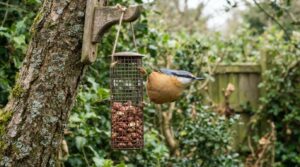
Peanuts and sunflower hearts bring nuthatches in, and they need mature trees nearby — this is a woodland-edge bird rather than an open-garden one. If you want them nesting, the box needs a 32mm hole, and they’ll plaster the entrance with mud to narrow it to their liking.
The nuthatch is the only British bird that habitually walks down a tree trunk head-first. Once you’ve seen it, nothing else moves like it.
They’re also spreading — nuthatches have expanded their range northwards across Britain over recent decades, so gardens that never had them may now be in range.
Nuthatch quick facts
- Size: about 14cm — sparrow-sized but stockier, almost neckless
- Key feature: climbs down trees head-first
- Best foods: peanuts, sunflower hearts, suet
- Nest box: 32mm hole — they’ll narrow it with mud themselves
- Needs: mature deciduous trees, ideally oak or beech
Identifying a nuthatch
Look for: blue-grey upperparts and warm buff-orange underparts, with a bold black stripe running through the eye from bill to nape. White cheeks and throat.
Shape: compact and stocky with a large head, very short tail, and almost no visible neck — a distinctive dumpy silhouette. The bill is long, straight and dagger-like.
Movement is the real identifier. Nuthatches move over bark in jerky, confident hops, going up, sideways and — uniquely among British birds — straight down head-first. Treecreepers only ever spiral upwards; woodpeckers brace with their tail and can’t descend head-down.
The call is loud and carrying: a ringing, repeated “twit twit twit” or a sharper “chwit”, often the first sign one is nearby.
Males and females are very similar, though males tend to have richer chestnut flanks.
Do you have the right garden?
Worth being honest about, because this is the bird where habitat matters most.
Nuthatches are woodland birds. They need mature deciduous trees — oak, beech, sycamore, lime — for feeding and nesting. A garden bordering woodland, a park, or a street with big established trees has a genuine chance. A new-build plot with fence panels and young saplings almost certainly doesn’t, however good the feeder.
They’re also largely absent from much of northern Scotland and Ireland, though the range has expanded north considerably in recent decades.
If you’re in the right sort of place, they’re one of the easier woodland birds to bring to a feeder.
What to feed them
Insects and spiders in summer; nuts and seeds in autumn and winter — which is when garden feeders come into play.
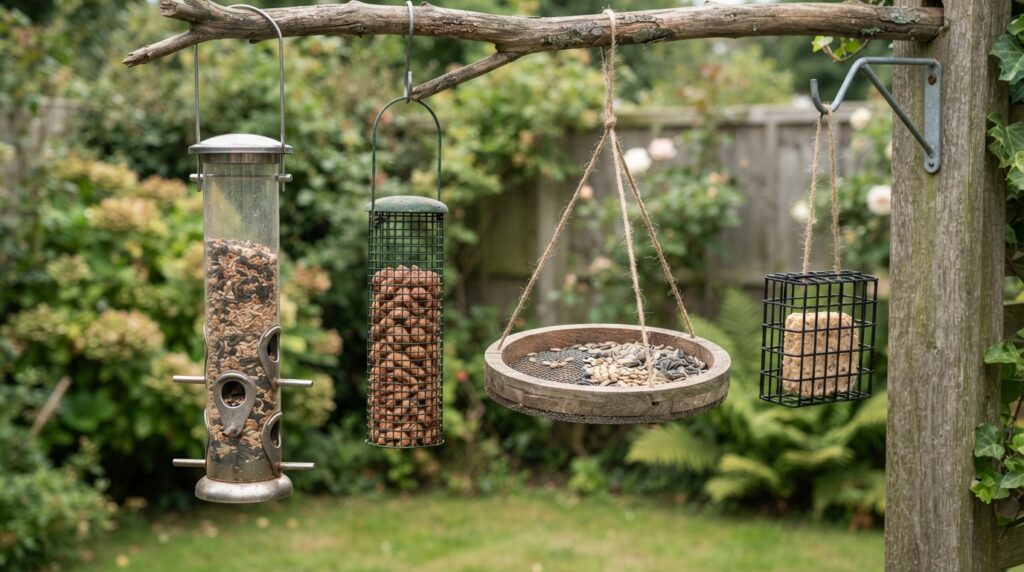
- Peanuts in a mesh feeder — a firm favourite, and aflatoxin-free bird-grade only
- Sunflower hearts — taken readily and easy for them to carry off
- Suet blocks and pellets
- Whole hazelnuts wedged into bark crevices, if you want to watch the hammering behaviour
Watch what they do with a seed. A nuthatch will take a nut, fly to a tree, wedge it firmly into a crack in the bark, and hammer it open with that dagger bill. The name comes from exactly this — “nut-hack” — and it’s genuinely satisfying to watch.
They also cache food, hiding seeds in bark crevices to retrieve later, so a nuthatch making repeated rapid trips to your feeder may be stockpiling rather than eating.
The mud plastering
One of the more remarkable things a British garden bird does.
Nuthatches nest in tree holes — usually old woodpecker holes — and if the entrance is larger than they want, they plaster it with mud to narrow it down. The mud dries hard, producing a snug entrance sized to keep larger birds and predators out.
They’ll do the same to a nest box, sealing round the hole and sometimes cementing the lid down entirely. It’s a good sign, not damage.
Nest box specification:
- 32mm entrance hole — the same size as for house sparrows
- Height 3–5m, on a mature tree trunk if possible
- Facing between north and east, away from strong sun and driving rain
- Sturdy construction — thin-walled boxes don’t survive the plastering and hammering
Put boxes up in autumn or early winter rather than spring. Our nest box guide covers siting properly.
If a nuthatch has sealed the lid down with mud, leave the box entirely alone until after the breeding season. Cleaning is done between September and January, and disturbing an active nest is an offence under the Wildlife and Countryside Act 1981.
How to attract them
- Hang a mesh peanut feeder — the single most effective step
- Add sunflower hearts and a suet feeder
- Site feeders near trees — nuthatches approach along trunks and branches rather than crossing open ground
- Put up a 32mm box on a mature tree, 3–5m up, facing north to east
- Leave dead wood standing where it’s safe to — insects, and natural cavities
- Plant or keep native trees if you have room, particularly oak and beech
- Feed through winter, when they’re most likely to visit gardens
They’re territorial year-round, so if a pair adopts your garden you’ll likely see the same birds repeatedly rather than a rotating cast.
Common questions
What’s the bird walking down my tree upside down?
A nuthatch. It’s the only British bird that routinely descends a trunk head-first — treecreepers only go up, and woodpeckers can’t manage it at all.
Why has mud appeared round my nest box hole?
A nuthatch has moved in and is narrowing the entrance to its preferred size. Leave it be — it’s normal and a good sign.
Why does it keep taking seeds and flying off?
Caching. Nuthatches hide food in bark crevices to retrieve later, so repeated rapid trips often mean stockpiling rather than eating.
I have feeders but no nuthatches. Why?
Most likely habitat rather than food. They need mature deciduous trees nearby. If your area has none, they’re unlikely regardless of what you offer.
Are nuthatches declining?
No — they’re one of the more encouraging stories. UK numbers have increased and the range has expanded northwards over recent decades.
Nuthatch or treecreeper?
Very different. Treecreepers are small, brown, streaky and mouse-like, with a fine downcurved bill, and only ever spiral upwards. Nuthatches are blue-grey and orange, stocky, with a straight dagger bill, and go both ways.
Related guides
- How to attract great spotted woodpeckers to your garden
- When to put up a nest box (and exactly where to site it)
- Best plants to attract birds to a UK garden
- Common garden birds in the UK: how to identify your visitors
Sources: RSPB species information and population trends; British Trust for Ornithology Nest Box Challenge and range expansion data; Woodland Trust; Wildlife and Countryside Act 1981.
Compare current prices on bird food and feeders at Amazon UK. Prices and stock change often, so it is worth checking before you commit.
Browse bird food →