Affiliate disclosure: some links on this page go to Amazon. If you buy through one we may earn a small commission, at no extra cost to you. Full disclosure.
The three that matter most: not cleaning feeders weekly, still using a bird table, and overfilling. All three were normal practice until recently, and all three are now known to contribute to disease spread. None of this is a reason to feel bad — the advice genuinely changed.
Several things on this list were standard advice for decades. If you’re doing them, you were following the guidance of the time — the guidance moved, in April 2026, after a substantial evidence review.
Worth reading in that spirit rather than as a telling-off.
The ten
- Not cleaning feeders often enough
- Still using a bird table
- Overfilling
- Buying cheap seed mix
- Leaving fat balls in netting
- Never moving the feeder
- Feeding seed in summer
- Offering water you can’t change daily
- Putting the feeder in the wrong place
- Giving up too soon
1. Not cleaning feeders often enough
The most consequential one.
Current guidance is to clean feeders at least weekly — hot soapy water, then a non-toxic disinfectant such as Ark-Klens or a mild 5% bleach solution, rinsed and dried completely before refilling.
Why it changed: trichomonosis, a parasitic disease spread through saliva and regurgitated food. Greenfinch numbers have fallen by around 67% since 1979 — over two million birds — and the species is now on the UK Red List. One infected bird can turn a busy feeder into a disease hotspot.
If your feeder can’t be taken apart properly, that’s the underlying problem. A feeder you can’t clean is one you’ll stop cleaning.
Our cleaning guide has the full method.
2. Still using a bird table
The hardest one for people to accept, because bird tables have been a fixture of British gardens for generations and are often inherited.
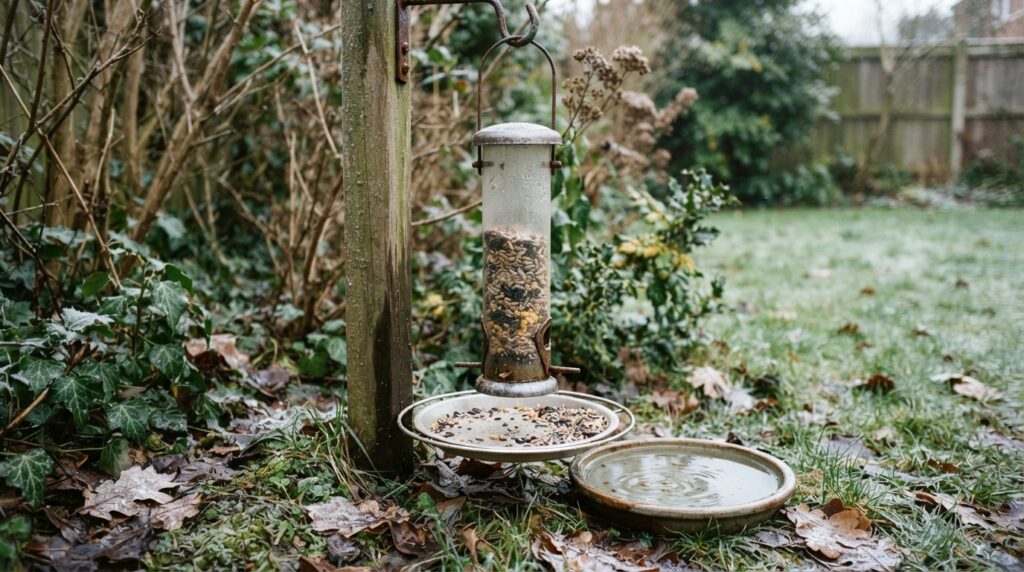
The RSPB now advises against all flat-surfaced feeders — bird tables, window feeders, ground feeding stations, and the seed trays fitted beneath many hanging feeders. It removed them from sale in December 2024.
The reasoning is specific: a bird with trichomonosis struggles to swallow and regurgitates contaminated food. On a flat surface that food sits there, damp, alongside droppings, and healthy birds pick it up. Even daily cleaning doesn’t reliably prevent it, because transmission happens between cleans.
If your hanging feeder has a tray, most clip off — that’s a free fix.
Our feeder types guide covers what to use instead.
3. Overfilling
Filling a feeder to the brim feels generous. It isn’t.
Current guidance is to feed in moderation, with seed and peanuts eaten within one to two days and suet within about seven. Food that sits gets damp, clumps, grows mould and has to be thrown away.
Little and often is better for the birds and cheaper for you — the two rarely align this neatly.
4. Buying cheap seed mix
Budget mixes are padded with wheat, barley, split peas, lentils and dried rice — bulk ingredients most garden birds won’t eat. Birds pick out the sunflower seeds and flick the rest onto the ground, where it rots and attracts rats.
So the cheap bag costs more per useful kilo than the expensive one, and creates a rat problem into the bargain.
Check the ingredients list. A good mix leads with sunflower hearts or black sunflower seeds. If wheat or split peas appear near the top, most of that bag is filler.
Sunflower hearts on their own are the simplest answer — no husk, almost no waste, taken by nearly everything.
5. Leaving fat balls in netting
Never leave fat balls in their plastic netting. Birds regularly get beaks and feet caught in it, causing serious injury and sometimes death. The RSPB is explicit about this.
Remove the netting and use a proper cage feeder, or buy fat balls sold loose.
Widely sold in netting, which is why so many people assume it’s how they’re meant to be used.
6. Never moving the feeder
The newest instruction, and the one most people haven’t heard.
Current guidance is to move feeders to a different spot after each weekly clean. Over weeks, dropped food and droppings accumulate in one patch of ground beneath a fixed feeder, creating a contaminated area that undoes the cleaning.
Clear the debris underneath as well while you’re at it.
If a bracket is fixed and can’t move, at minimum sweep beneath it thoroughly at every clean, and consider setting up a second position to alternate between.
7. Feeding seed all summer
Standard practice until 2026, and now advised against.
Current guidance is to pause seeds and peanuts from 1 May to 31 October, while small amounts of suet, fat balls and mealworms remain fine year-round.
Two reasons: disease risk peaks roughly July to October, and natural food is at its most abundant through those months.
Worth knowing this is genuinely contested. Several independent UK bird food retailers have publicly disagreed, and their central objection is reasonable — the pause covers the whole breeding season, when parent birds are working hardest. The RSPB acknowledges gaps in understanding and says it will monitor and may refine the advice.
Our seasonal feeding guide sets out both sides properly.
8. Offering water you can’t change daily
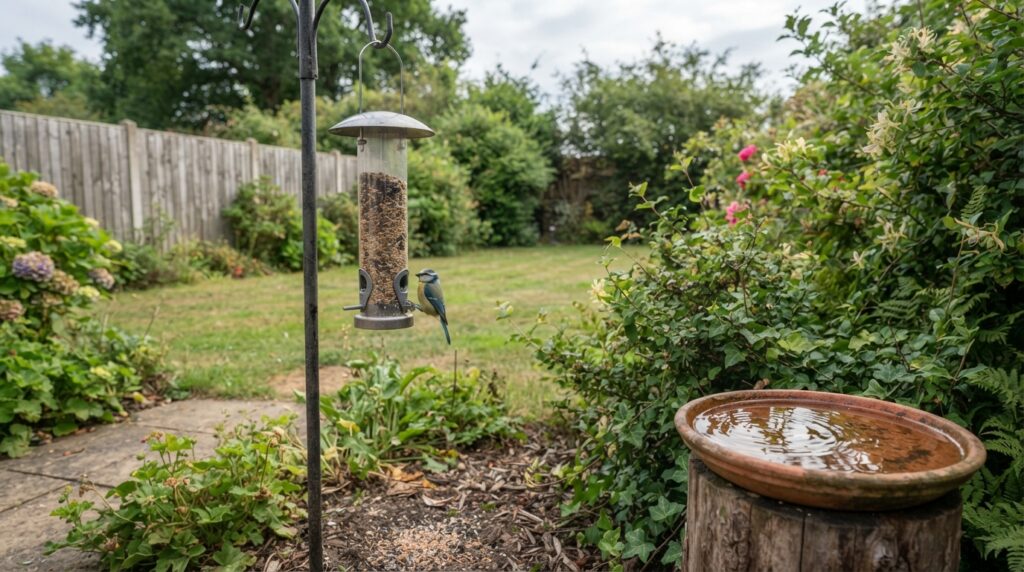
Water is genuinely valuable — often more so than food. But the parasite behind trichomonosis survives in water, so a bath that sits for a week is a transmission route rather than a kindness.
The guidance is blunt: only offer water if you can change it every day, using fresh tap water, and clean the bath weekly.
If daily isn’t realistic, it’s genuinely better not to offer it at all.
And never add anything to stop it freezing. Salt, antifreeze, glycerine and oil are all harmful — salt destroys feather waterproofing, antifreeze is lethal. Warm water and a floating ball are the safe methods.
9. Putting the feeder in the wrong place
Placement decides whether a feeder gets used at all, and both extremes fail.
- Too exposed — no cover within reach means nowhere to bolt to. Birds avoid it
- Too enclosed — right against a hedge is an ambush point for cats
- The workable middle is about 2m from cover, roughly 1.5m off the ground
- 3m from any squirrel launch point — fence, shed roof, branch, bench, wheelie bin
- Either within 1m of a window or beyond 10m. The middle distance is where birds build up enough speed to injure themselves on the glass
- Not under branches birds roost on
10. Giving up too soon
The most common reason people conclude bird feeding “doesn’t work”.
A new feeder in a garden birds haven’t fed in can take several weeks to be found and trusted. Three to four weeks is entirely normal; longer in a bare or new-build garden.
The mistake compounds when people respond by moving the feeder repeatedly, which resets the clock each time. Pick a sensible position, use sunflower hearts, and leave it alone for a month.
Our guide on why birds aren’t coming works through the other causes.
A few smaller ones
| Mistake | Why it matters |
|---|---|
| Supermarket peanuts | Can carry aflatoxin, a fungal toxin that kills birds. Only bird-grade, from a reputable supplier |
| Loose peanuts in an open dish | Whole nuts carried to a nest can choke chicks. Mesh feeders only |
| Bread | Not poisonous, but fills birds up with almost nothing useful |
| Cooked porridge | Sets hard around the beak. Raw oats are fine |
| Greasing the pole for squirrels | Mats fur and transfers to feathers, destroying waterproofing. Genuinely harmful |
| Storing food in paper sacks | Rats chew straight through. Use a sealed metal bin |
| Clustering all feeders together | Concentrates birds. Guidance says spread them out |
| Cleaning feeders in the kitchen sink | Do it outdoors, with dedicated brushes and gloves |
Getting it right, in one list
- Sunflower hearts in a tube feeder that fully dismantles, no base tray
- A suet cage as the second feeder — approved year-round
- Small amounts, topped up every couple of days
- Clean weekly, move to a fresh spot, clear the ground beneath
- Water only if you’ll change it daily
- Seeds and peanuts 1 November to 30 April; suet and mealworms year-round
- About 2m from cover, 1.5m up, 3m from squirrel launch points
- Give a new feeder a month before judging it
Common questions
I’ve been doing several of these for years. Have I harmed birds?
Almost certainly not in any way you could have known about. Most of these were standard advice until 2026 and were recommended by the same organisations now advising against them. The evidence moved. Changing now is the useful response.
Do I really have to stop using my bird table?
It’s guidance, not law. But the reasoning is specific and well-evidenced rather than precautionary, and it comes from a structured evidence review. Some people repurpose theirs as a plant stand.
Is weekly cleaning really necessary?
It’s the current recommendation from the RSPB, arrived at with the BTO and the Institute of Zoology. Given the greenfinch numbers, it’s a reasonable ask.
What if I can only manage some of this?
Do the cleaning and lose the flat surfaces. Those two carry most of the benefit. Everything else is refinement.
Should I just stop feeding to be safe?
No. Feeding done properly is beneficial, and roughly 16 million UK households do it. The point of the guidance is to feed hygienically and seasonally, not to stop.
Related guides
- When to feed garden birds: the new UK guidance explained
- How to clean a bird feeder — and why it now matters more
- Types of bird feeder: which one should you actually buy?
- Best bird food for winter: what to put out and what to skip
Sources: RSPB feeding and hygiene guidance (April 2026); RSPB flat-surface feeder sales suspension (December 2024); British Trust for Ornithology seasonal feeding FAQs; RSPB Big Garden Birdwatch population trends; Garden Wildlife Health.
Compare sunflower hearts and suet at Amazon UK. Prices and stock change often, so it is worth checking before you commit.
Browse bird food →