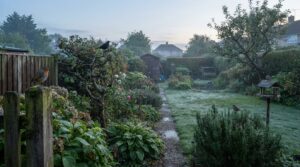
Birds sing at dawn because sound carries further in still, cool air, it’s too dark to forage productively, and a male singing hard at first light is advertising that he survived the night in good condition. The order is fairly consistent: blackbird and robin first, then song thrush and wren, with finches and sparrows joining later.
Between late April and May, the half hour before sunrise is the loudest time of year in a British garden — and it’s happening whether or not anyone is awake for it.
The good news is that the dawn chorus is one of the easiest things in nature to appreciate properly, because you can do it from bed with the window open.
The essentials
- Peak season: late April to May
- Peak time: roughly the hour before sunrise
- First to sing: usually blackbird or robin
- Best conditions: still, dry, mild mornings
- International Dawn Chorus Day: the first Sunday in May
Why they do it
Several explanations, all likely contributing.
Sound carries better. In the cool, still air before sunrise, with little wind and less thermal turbulence, birdsong travels considerably further than it does later in the day. A male gets more range for the same effort.
It’s too dark to feed. Foraging for insects and seeds needs light. The pre-dawn window is time that can’t be spent eating, so singing costs less than it would at midday.
It’s a fitness signal. Singing loudly at first light, after a long cold night without food, demonstrates that a male came through in good condition. A weak or hungry bird can’t afford it. Females appear to pay attention.
Territories need re-establishing. Overnight, birds die or move. Dawn is when a male reasserts a claim and checks whether neighbours are still there.
Who starts, and the running order
The sequence is reasonably consistent, and appears to relate partly to eye size — birds with larger eyes can see in lower light and start earlier.
| Roughly when | Who | What to listen for |
|---|---|---|
| First, well before light | Blackbird | Rich, mellow, unhurried fluting from a rooftop |
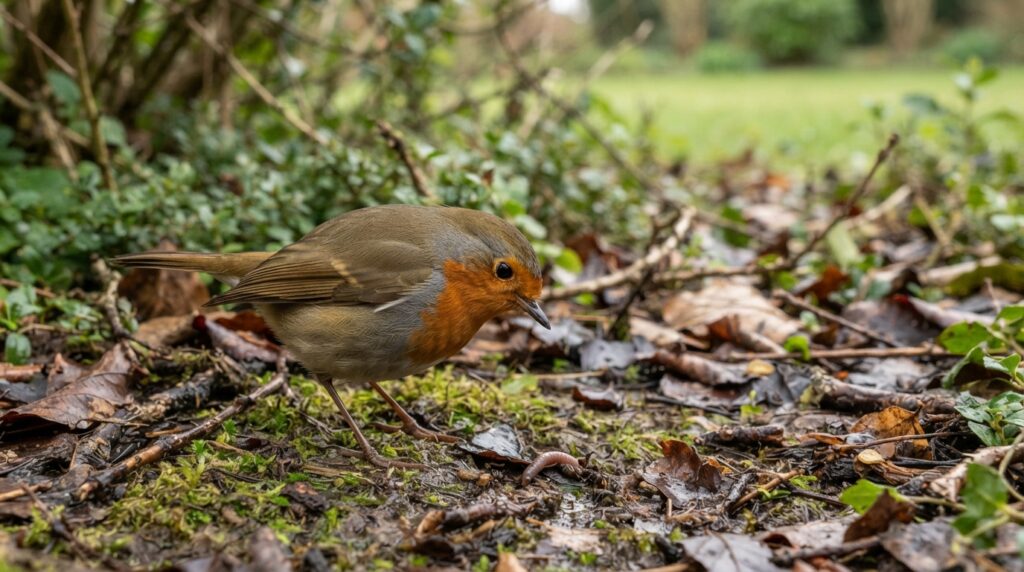
| Very early | Robin | Wistful, silvery, variable — also sings at night under streetlights |
| Early | Song thrush | Clear phrases, each repeated two or three times |
| Early | Wren | Explosive rapid trill, astonishingly loud |
| Building | Great tit | Ringing two-note “tea-cher, tea-cher” |
| Building | Blue tit | High trilling notes |
| Later | Chaffinch | Accelerating descending phrase with a flourish |
| Later | Goldfinch | Liquid tinkling twitter |
| Last | House sparrow, woodpigeon | Chirping; five-note cooing |
A practical tip for learning: don’t try to identify everything at once. Pick out the blackbird — the first, richest, most unhurried voice — and then the robin. Two species is a real achievement on a first attempt, and everything else gets easier once you can subtract those two.
When to listen
Season: the chorus builds from March, peaks in late April and May, and fades through June as birds stop defending territories and begin moulting. By late July gardens are noticeably quiet.
Time: it starts roughly an hour before sunrise and peaks around 30 to 45 minutes before. In early May that means being awake somewhere around 4am — the reason most people never hear it properly.
Conditions: still, dry, mild mornings are best. Wind and heavy rain suppress it considerably.
International Dawn Chorus Day falls on the first Sunday in May, and wildlife trusts, RSPB reserves and local groups run guided early-morning walks. Genuinely worth doing once — someone else identifying the birds live is worth a great deal more than any recording.
How to listen properly
- Open a window the night before and listen from bed. No equipment, no getting up in the dark
- Go outside if you can manage it — a garden or park gives far more than a bedroom
- Stay put for at least 20 minutes. The chorus builds, and the interest is in the sequence
- Face away from roads. Traffic noise masks the quieter singers
- Use the Merlin Bird ID app if you want help — it identifies UK species from live sound and is genuinely good. Treat it as a teacher rather than an oracle; it makes mistakes in a busy chorus
- Record a minute on your phone and listen back later. You’ll hear things you missed live
Why urban birds sing differently
Worth knowing if you live in a town.
Research has found that birds in noisy urban areas often sing louder, at a higher pitch, and earlier than their rural counterparts. Higher frequencies cut through low-frequency traffic noise more effectively, and starting earlier means singing before the rush hour.
Artificial light also plays a part. Robins in particular will sing through the night under streetlights, which is why night singing is so often reported in towns — see our guide on birds singing at night.
Why it goes quiet
By late June the chorus thins noticeably, and by July and August gardens can seem almost silent.
Two reasons: territories no longer need defending once breeding is finishing, and birds enter their annual moult, which is energetically demanding and makes them quiet and secretive.
It isn’t that the birds have left. Our guide on moulting and scruffy birds covers what’s happening.
Common questions
What bird sings first in the morning?
Usually the blackbird, often well before it’s light, closely followed by the robin. Both have relatively large eyes for their size, which may be why they start earliest.
Why do birds sing at 4am specifically?
It isn’t the clock time that matters — it’s the hour before sunrise. In May that happens to fall around 4am in much of the UK.
Do female birds sing?
Some do, more than was once assumed, though in most British garden species the sustained territorial song is the male’s. Robins are an exception — females hold winter territories and sing.
Is something wrong if my garden is silent in July?
No. Breeding is over and birds are moulting, which makes them quiet and secretive. Normal every year.
What’s singing in the middle of the night?
Almost always a robin, usually under a streetlight. Occasionally a blackbird. See our night singing guide.
Is there an app that identifies birdsong?
Merlin Bird ID handles UK species well and works from live sound. It’s a good learning tool, though it can struggle when many birds sing at once.
Related guides
- Which bird is singing at night?
- When do birds nest in the UK? A month-by-month guide
- Why is my blackbird bald? Scruffy birds in late summer explained
- Common garden birds in the UK: how to identify your visitors
Sources: RSPB guidance on birdsong and the dawn chorus; British Trust for Ornithology; Woodland Trust; published research on urban birdsong frequency and timing.
Compare current prices on bird food and feeders at Amazon UK. Prices and stock change often, so it is worth checking before you commit.
Browse bird food →