Affiliate disclosure: some links on this page go to Amazon. If you buy through one we may earn a small commission, at no extra cost to you. Full disclosure.
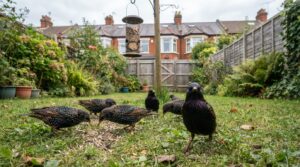
Starlings look black at a distance and are iridescent green and purple with white speckling up close. They walk rather than hop, which is the quickest way to tell them from a blackbird. Despite arriving in noisy flocks, they’re Red Listed after a severe UK decline — so a caged feeder for the small birds plus a separate suet feeder for them is a fairer answer than driving them off.
Starlings divide opinion more than any other garden bird. They arrive as a mob, empty a suet feeder in an afternoon, and squabble loudly the whole time.
They’re also one of the UK’s fastest-declining birds, which makes the “get rid of them” instinct harder to justify than it feels.
Starling quick facts
- Size: about 21cm — slightly smaller than a blackbird
- Key features: iridescent sheen, white speckling in winter, short square tail
- Behaviour: walks (blackbirds hop). Arrives in flocks
- Status: UK Red List of conservation concern
- Nest box: 45mm hole, 2.5m or higher
Identifying a starling
Winter: black with a strong green and purple iridescence, heavily spangled with small white spots. The bill is dark.
Summer: the white speckling wears away, leaving a glossier, darker bird, and the bill turns bright yellow.
Shape: upright, short square-ended tail, pointed triangular wings that give a distinctive arrow-like silhouette in flight. Pink-red legs.
Juveniles look like a completely different species — plain dull grey-brown all over with no iridescence and no spots. In midsummer you’ll often see mixed groups of glossy adults and drab brown youngsters, which confuses people every year.
Starling or blackbird?
| Starling | Blackbird | |
|---|---|---|
| Movement | Walks | Hops |
| Tail | Short, square | Long |
| Bill | Pointed; yellow in summer, dark in winter | Blunt, bright orange (male) |
| Plumage | Iridescent, speckled in winter | Plain glossy black (male), brown (female) |
| Company | Flocks | Alone or in pairs |
The walk is the fastest tell. Starlings stride purposefully across a lawn; blackbirds hop and pause. You can identify them from a distance on movement alone.
The mimicry
Starlings are exceptional vocal mimics, and it’s one of the genuinely remarkable things happening in an ordinary garden.
A starling’s song is a long, rambling sequence of whistles, clicks, rattles and gurgles — with impersonations woven through it. Commonly copied: other bird species, car alarms, mobile phone ringtones, reversing beepers, and squeaky gates.
Males with larger repertoires appear to do better in attracting mates, which is thought to be why the mimicry exists — a bigger vocabulary signals an older, more experienced bird.
If you’ve heard what sounded like a car alarm coming from a rooftop, or a phone ringing in a tree, that was almost certainly a starling.
Murmurations
The winter spectacle: thousands of starlings wheeling in coordinated clouds before dropping into a roost at dusk.
Roosts form in reedbeds, woodland, and often on human structures — piers, bridges and city buildings. Numbers can reach into the tens or hundreds of thousands.
What they’re for isn’t settled, but the leading explanations are that the swirling mass makes it hard for a predator such as a peregrine to single out an individual, that gathering in numbers keeps birds warmer overnight, and that the display helps birds locate a good roost site.
Best time to look: November to February, in the half hour before sunset. UK numbers are boosted through winter by birds arriving from continental Europe, which is why garden flocks grow noticeably from October.
Why a common bird is Red Listed
This surprises people, understandably — a bird arriving thirty at a time doesn’t feel endangered.
But the UK breeding population has fallen severely since the 1970s, and Red Listing reflects the rate of decline rather than current abundance. Starlings remain numerous while having lost a very large share of their numbers.
Factors usually cited:
- Loss of nest sites — starlings nest in cavities in buildings, and modern construction and renovation seal them off
- Reduced invertebrate food — starlings feed heavily on leatherjackets and other soil invertebrates in short grassland. Changes in land management have reduced availability
- Lower survival of young birds in their first year, which appears to be a significant driver
Worth holding both facts at once: the flock at your feeder is real, and so is the decline.
Living with them at the feeder
They can genuinely dominate. A flock will strip a suet feeder in a session and deter smaller birds while they’re at it. That’s a fair thing to want to manage.
The approach that works — and is fair:
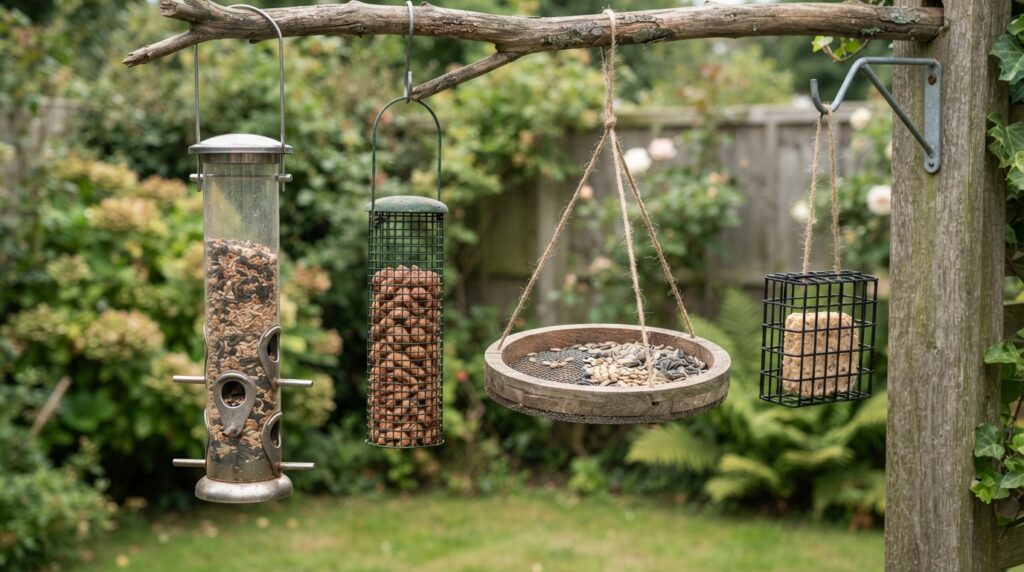
- A caged feeder for the small birds. Mesh admits tits, finches and sparrows and excludes starlings and pigeons
- Plus one uncaged suet feeder elsewhere in the garden, that the starlings can use
Everyone eats, nobody is driven out, and given the conservation picture that seems a more defensible outcome than exclusion alone.
Other things that help: avoid wheat-heavy mixes (which pull in the larger birds), remove any flat surfaces they can stand on, and feed smaller amounts more often so a single flock visit can’t clear everything.
Our guide to stopping larger birds hogging the feeder goes into detail.
All wild birds are protected under the Wildlife and Countryside Act 1981. Exclusion is the appropriate approach — trapping or harming starlings is not a lawful response to them eating bird food.
Helping them instead
If you’d rather work with them than against them:
- Put up a starling nest box — 45mm hole, fixed 2.5m or higher, ideally under eaves. Nest sites are one of their main constraints, and very few people provide one
- Keep some short grass unsprayed — starlings probe lawns for leatherjackets, and a lawn treated with pesticide gives them nothing
- Offer suet, which is what they most want and is approved year-round
- Protect roof nest sites if you already have them, rather than sealing the gap. See our roof nesting guide
Common questions
Why do I suddenly have so many starlings?
UK numbers are boosted in autumn and winter by birds arriving from continental Europe. Garden flocks typically grow from October and thin out again in spring.
What’s the bird copying a car alarm?
A starling. Males weave mimicked sounds into their song, and mechanical noises are common favourites.
Why are the brown ones with them?
Juveniles. Young starlings are plain grey-brown with no spots or iridescence and look like a different species entirely until they moult in late summer.
Is it wrong to exclude them from a feeder?
Excluding them from one feeder so smaller birds can eat is reasonable garden management. Driving them out of the garden entirely is harder to justify for a Red Listed species — providing a separate suet feeder is a fair compromise.
Can I stop them nesting in my roof?
Not while a nest is active — that’s an offence. Any repair must wait until September to February, and putting up a nest box nearby first is worth doing given how scarce nest sites are.
Where can I see a murmuration?
Large winter roosts form at reedbeds, piers and some urban sites. Local wildlife trusts usually publicise the best nearby spots — go about half an hour before sunset, November to February.
Related guides
- Black birds in your garden: crow, rook, jackdaw or something else?
- How to stop pigeons and starlings taking all the bird food
- Birds nesting in your roof or eaves: what you can and can’t do
- Common garden birds in the UK: how to identify your visitors
Sources: RSPB species information and conservation status listings; British Trust for Ornithology population trends and research on starling declines; RSPB Big Garden Birdwatch results; Wildlife and Countryside Act 1981.
Compare rodent-proof seed storage at Amazon UK. Prices and stock change often, so it is worth checking before you commit.
Browse seed storage →