Affiliate disclosure: the link on this page goes to Amazon. If you buy through it we may earn a small commission, at no extra cost to you. Full disclosure.
If you’re lying awake listening to a bird singing in the small hours, it’s almost certainly a robin.
Nightingales get the credit and are hardly ever responsible — they’re scarce in the UK, confined largely to the south-east, and present only from April to July. Robins are everywhere, sing all year, and are the species most affected by street lighting.
Who’s likely singing
- Robin — by far the most common night singer. Year-round, especially near lights
- Blackbird — occasionally pre-dawn, especially in spring
- Song thrush — sometimes very early, repeating each phrase
- Tawny owl — the classic “twit-twoo”, actually two birds calling
- Nightingale — genuinely rare, south-east only, April to July
Why robins sing at night
Two reasons, and they compound each other.
Artificial light. Robins are unusually sensitive to light levels — they have relatively large eyes and forage in low light. A street lamp, security light or lit shop front can be enough to convince a robin that dawn has arrived, or simply that conditions are bright enough to sing. This is why urban and suburban robins sing at night far more than rural ones.
Territory. Robins are unusual among British birds in holding territory all year round, not just in the breeding season. Both males and females sing in winter, each defending separate territory. Song is how they advertise ownership, and in a busy environment there’s an incentive to do it when it’s quieter and carries further.
Research has also suggested that in noisy urban areas, some birds shift singing to quieter night hours simply to be heard over daytime traffic.
How to tell what you’re hearing
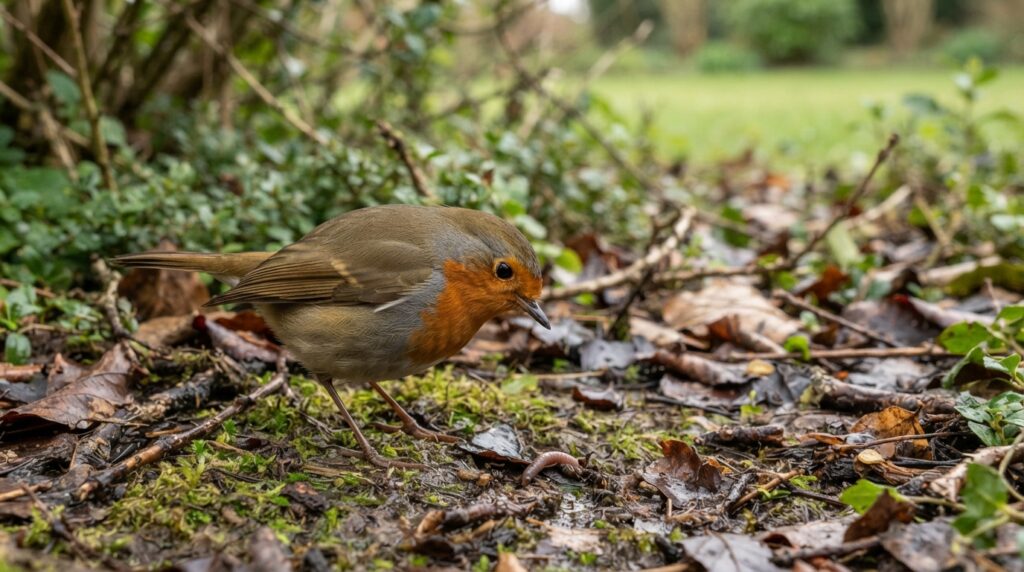
Robin
A wistful, silvery warble — a series of short, varied phrases with pauses between them, rising and falling. Not a repeated pattern. The winter song is often described as thinner and more melancholy than the spring version. Usually from a single fixed spot, often a hedge, aerial or gutter.
Blackbird
Much richer and more fluty, with longer, more leisurely phrases and a distinctive slurred, mellow tone. Blackbirds sing mostly at dawn and dusk, but in spring will start remarkably early — sometimes well before 4am. Usually from high up: a rooftop, chimney or tall tree.
Song thrush
Clear, loud, bell-like phrases — and the giveaway is that each phrase is repeated two or three times before it moves on to a new one. Once you’ve noticed the repetition you can’t mistake it. Often one of the earliest singers before dawn.
Tawny owl
Not song, but calls. The familiar “twit-twoo” is actually two birds: the female’s sharp “ke-wick” and the male’s quavering hoot in response. Most vocal in autumn, when young birds are establishing territories, and again in late winter.
Nightingale
Genuinely extraordinary if you hear one — powerful, varied, with deep fluting notes, rapid trills and a characteristic crescendo of repeated piping. Loud enough to be startling.
But be realistic: UK nightingales are largely restricted to south-east England, favour dense scrub and coppiced woodland rather than gardens, and are present only from mid-April to July. Numbers have declined severely. If you’re in Manchester in November, it isn’t a nightingale.
Other possibilities
- Sedge and reed warblers — near water, spring and summer, a scratchy chattering
- Oystercatchers and other waders — piping calls overhead in coastal and estuary towns
- Redwings — a thin “seep” call from birds migrating overhead on autumn nights, easily missed
- Foxes — worth mentioning, because the vixen’s scream in winter is regularly mistaken for a bird or something worse
The dawn chorus, and why it starts so early
If what you’re hearing is between roughly 3.30am and 5am in spring, you may simply be catching the start of the dawn chorus rather than genuine night singing.
Birds sing at dawn in a fairly consistent order, generally with the largest-eyed species starting first because they can see earliest. Blackbirds, robins and song thrushes are typically among the earliest; tits and finches come later.
The chorus peaks between March and July, and is at its most intense in May.
If it’s keeping you awake
There’s no way to stop a bird singing, and all wild birds are legally protected — so the practical options are about you rather than the bird.
- Reduce light near the roost. If a security light, porch light or garden light is on all night, switching it off or fitting a shorter motion-sensor timer can genuinely help. This is the one thing that addresses the cause
- Blackout curtains and earplugs — unglamorous but effective
- White noise masks the intermittent quality that makes birdsong so noticeable
- Move to a different room temporarily, if that’s an option
What not to do: don’t try to disturb, deter or move the bird. All wild birds are protected under the Wildlife and Countryside Act 1981, and interfering with nesting birds is an offence. Cutting back the hedge it’s singing from between March and August risks destroying an active nest.
Some perspective: night singing is most intense during the breeding season and tails off considerably by late summer. It’s a seasonal problem, not a permanent one.
Working it out for yourself
- Record it on your phone. Even a poor recording through a window is usually identifiable
- The Merlin Bird ID app identifies UK birds from sound and handles night recordings well
- Note the time and season — this narrows it substantially
- Note whether it’s near a light — a strong pointer towards a robin
- Listen for structure — repeated phrases suggest song thrush; varied warbling phrases suggest robin; rich fluting suggests blackbird
Common questions
Is a bird singing at night a bad sign?
No — it’s normal behaviour, not distress. Usually a robin responding to artificial light or defending territory.
Do robins sing at night in winter too?
Yes. Robins hold territory year-round and sing through the winter, which is unusual among British birds. Night singing isn’t confined to spring.
Could it really be a nightingale?
Possible if you’re in south-east England between mid-April and July, near scrub or coppiced woodland. Otherwise, very unlikely.
Why has it started suddenly?
Often a change in lighting — a new street lamp, a neighbour’s security light, or building work. Sometimes just the season, as territorial singing ramps up in late winter.
Do female robins sing?
Yes, particularly in winter when they hold their own separate territories. Unusual among UK garden birds and a genuinely interesting quirk of the species.
How long will it go on for?
Night singing peaks through the breeding season and reduces markedly by late summer. If light is the trigger, it can persist year-round — which is why addressing the lighting is the most effective response.
Related guides
- What do robins eat? Feeding Britain’s favourite garden bird
- What do blackbirds eat? How to feed and attract them
- Common garden birds in the UK: how to identify your visitors
- Where do garden birds sleep at night?
Sources: RSPB species information on robins, blackbirds, song thrushes and nightingales; British Trust for Ornithology research on urban birdsong and artificial light; RSPB dawn chorus guidance; Wildlife and Countryside Act 1981.
Compare current prices on bird food and feeders at Amazon UK. Prices and stock change often, so it is worth checking before you commit.
Browse bird food →