Beakfeeder is reader-supported. If you buy through our Amazon links we may earn a small commission at no extra cost to you.
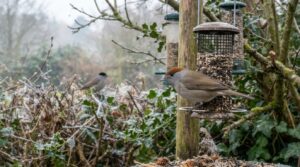
A grey warbler with a neat cap — black on the male, chestnut-brown on the female. Most blackcaps breeding in Britain migrate south for winter, but a separate population from central Europe now flies north-west to spend the winter here, and many of them rely on garden feeders. If you see one in December eating fat or apple, it’s probably a German or Austrian bird.
- Size: about 13 cm — a little smaller than a house sparrow.
- Male: grey-brown body, jet-black cap.
- Female and young: same body, rusty-brown cap.
- Winter food: fat, suet, sunflower hearts, apples, berries.
- Status: Green-listed; breeding numbers have increased strongly in recent decades.
How to identify a blackcap
The cap is everything. It sits neatly on top of the head, stopping level with the eye — it doesn’t extend down onto the cheeks or chin. The rest of the bird is a plain, soft grey, slightly browner on the back, with no wing bars or streaks. The bill is thin and pointed, like all warblers.
- Male: glossy black cap, grey face and underparts.
- Female: chestnut or ginger-brown cap, slightly warmer brown body.
- Juvenile: similar to the female, with a duller brown cap; young males moult into black.
Blackcap or something else?
| Bird | Key difference |
|---|---|
| Coal tit | Black head extends down the face with white cheeks and a white patch on the nape. Blackcaps have no white. |
| Marsh or willow tit | Black cap plus a black bib under the bill, buff cheeks. Blackcaps have no bib. |
| Great tit | Black head and a black stripe down a yellow chest. |
| Reed bunting (male) | Whole head black with a white moustache and collar; not usually a garden bird. |
Why blackcaps winter in Britain
Until the second half of the twentieth century, a blackcap in winter was a rarity. Our breeding birds still leave for Iberia and North Africa each autumn. But ringing studies have shown that birds from southern Germany and Austria have increasingly migrated north-west to Britain and Ireland instead of south-west to Spain. Milder winters and plentiful garden food make it a good bet, and research has found these birds can return to their breeding grounds earlier and in better condition.
That means a blackcap you see in summer and a blackcap you see in January are likely to be different individuals from different places.
Citizen science: BTO Garden BirdWatch has been tracking winter blackcaps in gardens for years. Recording your sightings helps show how this migration is changing.
What blackcaps eat
In summer blackcaps feed on insects. In autumn and winter they switch heavily to fruit and, in gardens, fat. Offer:
- Suet and fat balls — a favourite; year-round under RSPB guidance.
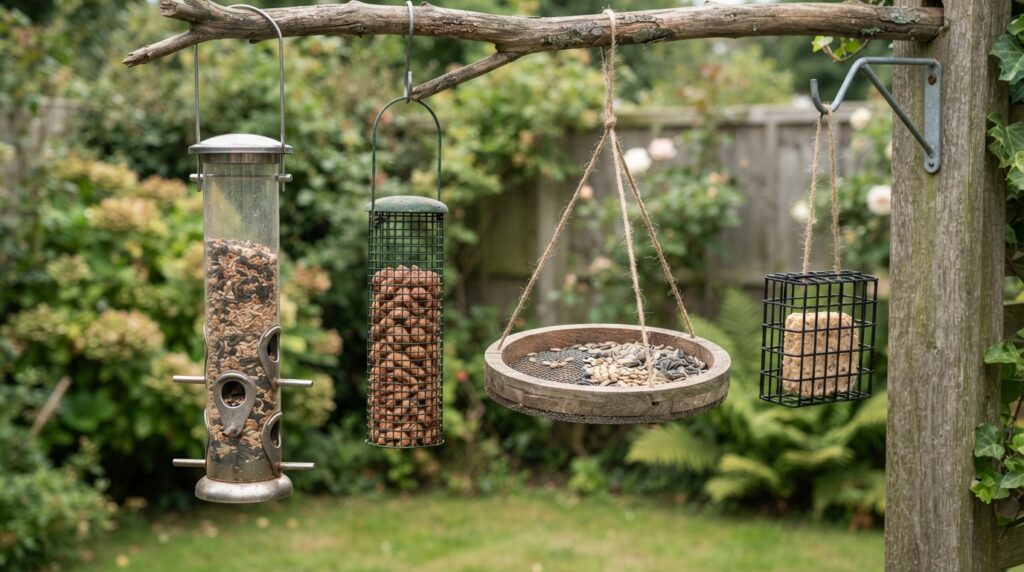
- Halved apples and pears — spike onto a branch or put on a hanging dish.
- Berry shrubs — holly, ivy, cotoneaster, pyracantha and mistletoe.
- Sunflower hearts and soaked sultanas — from November, when seed feeding resumes under current guidance.
Keep dried fruit away from gardens with dogs — sultanas and raisins are toxic to them.
Behaviour: the feeder bully
Winter blackcaps are surprisingly feisty. A single male will often guard a fat feeder, chasing off blue tits and even larger birds. If you have one, offering food in two or three spread-out spots lets everyone else eat.
Song
The blackcap’s song, heard from late March, is rich, fluty and fast — sometimes called the “northern nightingale”. It often starts with a scratchy warble before breaking into clear notes. The call is a hard “tak”, like two pebbles knocked together.
Common questions
Is a blackcap a tit?
No, it’s a warbler — related to chiffchaffs and whitethroats, not tits.
Why is my blackcap’s cap brown?
It’s a female or a young bird. Only adult males have a black cap.
When do winter blackcaps leave?
Most wintering birds head back to the continent in March and early April, around the time our breeding birds return from the south.
Are blackcaps rare?
No. They are common breeders in UK woodland and larger gardens, and winter numbers in gardens have grown.
Related guides
- Winter visitors to UK gardens
- Coal tit identification guide
- UK bird migration in winter
- Holly, ivy and mistletoe for birds
Sources: BTO BirdFacts and Garden BirdWatch; RSPB species profile for blackcap; published ringing studies on central European blackcaps wintering in Britain and Ireland.
Compare hanging bird feeders at Amazon UK. Prices and stock change often, so it is worth checking before you commit.
Browse bird feeders →